TL;DR
We didn’t ‘feature’ our way to growth. We fixed trust + usability first, built a brand people believed, then earned the right to build smarter guidance.
Baseline
2.5%
paid conversion rate
Outcome
25%
paid conversion rate
Background
When I joined NewRetirement (now Boldin), the company had been operating for ~8 years with no dedicated design or product function. They’d built a real business—financial planning software funded by a reverse-mortgage leads operation—and had just closed their Seed round, which funded their first Head of Design (me) and Head of Product.
Starting point
Conversion was low, design debt was high
The projection engine was powerful, but the experience wasn’t built for usability or trust.
100k+ registrations, only ~2.5% conversion to paid
Mobile effectively unsupported
Brand and UI felt stuck in 2008
High friction in the moments users needed clarity and confidence
Leadership wanted big bets (AI), but foundation couldn’t support more complexity
The challenge
The team was excited to have design, but didn’t yet know how to work with it or how it drives outcomes. Meanwhile, our founder had ambitious ideas for where design could go next—up to and including an AI coach. With a team of one, I needed to show a path from “design debt” to “design as a business lever,” without spreading design across a hundred disconnected initiatives.
The inflection point
Three months in (Nov 2020), the founder asked every department head to create a 2021 roadmap. I didn’t want design publishing something that conflicted with product—we were aligned and working toward the same outcomes—and I didn’t want foundational work to get cut because it wasn’t flashy.
Leadership wanted to move fast toward big bets like AI. But the product foundation wasn’t stable enough to support more complexity. The CTO, Head of Product, and I aligned we needed to improve fundamentals first—usability, consistency, and trust—then earn the right to pursue larger “intelligence” bets.
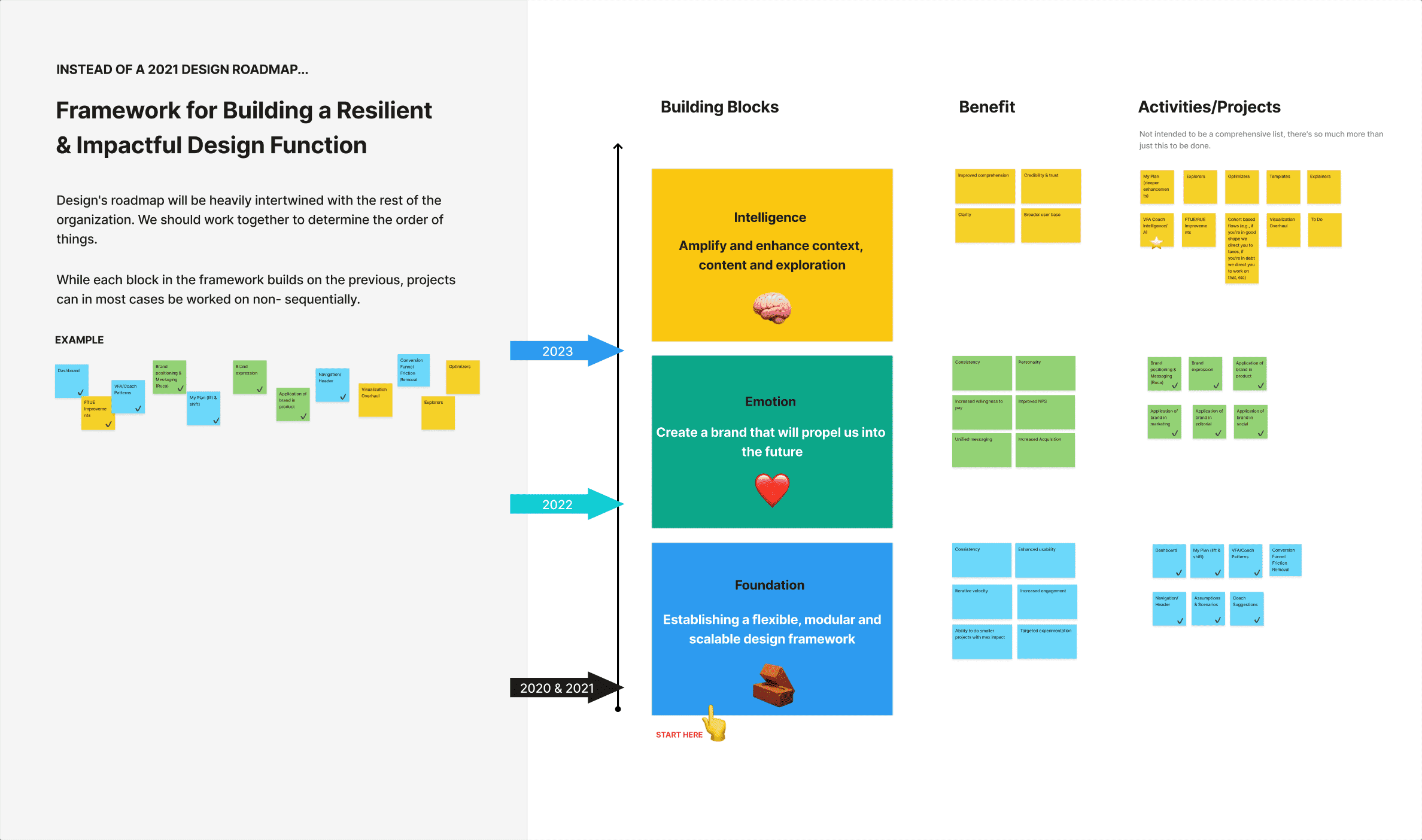
The framework
Three building blocks that ladder to business outcomes
I structured the vision into three building blocks. Each one had:
A clear definition
The business benefit it unlocks
Example initiatives (so it didn’t feel like a philosophy lecture)
1
Foundation
Goal
Establish a flexible, modular, scalable product design framework to reduce drop-off and increase velocity.
Why it mattered
We couldn’t “feature” our way out of design debt. Without consistency and usable patterns, every new feature would compound the mess—more support burden, more confusion, more drop-off.
Benefits unlocked
Consistency
Enhanced usability
Better velocity
Increased engagement
Ability to do smaller projects with maximum impact
Targeted experimentation
Example work
“My Plan” lift + shift (modernize core experience without rewriting everything at once)
Navigation/header system
Coach suggestions + reusable coach patterns
Conversion funnel friction removal
2
Emotion
Goal
Create a brand that propels us into the future and increases willingness to pay.
Why it mattered
Our product required trust. People don’t hand you their retirement life story if the experience feels like a 2008 spreadsheet simulator. We needed credibility, cohesion, and a brand that could scale beyond the founders.
Benefits unlocked
Consistency + recognizable personality
Unified messaging
Improved NPS
Increased willingness to pay
Increased acquisition
Example work
Brand positioning & messaging (relaunch)
Brand expression system
Applying the brand consistently across: product, marketing, editorial, social
3
Intelligence
Goal
Amplify and enhance context, content, and exploration to increase clarity and guidance.
Why it mattered
This was the founder’s dream zone—AI coach, guidance, more “magic.” The framework didn’t shut that down. It sequenced it: we earn the right to build Intelligence by fixing Foundation and Emotion first.
Benefits unlocked
Improved conversion
Greater clarity
Credibility & trust
Broader user base
Example work
Cohort-based flows (guide people differently based on their situation)
Visualization overhaul
“To-do” and guided next steps
Templates / explainers
Explorers / optimizers paths
AI coach (positioned as a future layer, not step one)
How I got buy-in (without making it feel like “design said so”)
This wasn’t a deck I tossed over the fence. I used it as a shared alignment tool with the CEO, CTO, and Head of Product.
What made it work:
It was paired with concrete projects leadership already wanted (so it felt real).
It translated design work into outcomes (conversion, trust, velocity), not aesthetics.
It gave the founder a “yes, and…”: yes to AI/coach dreams—after we stabilize the product experience.
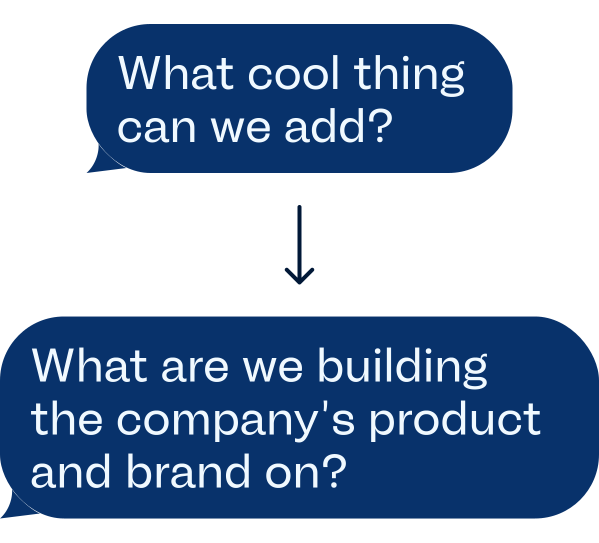
The result was a shift in the conversation from:
The resourcing plan:
Tying the vision to hiring
A multi-year vision is useless if it assumes infinite capacity. I paired the framework with a scaling & hiring plan that explained the tradeoff curve:
Too many designers too early → design gets far ahead of engineering and creates a painful gap.
Too few designers → design becomes a bottleneck and can’t show up where it needs to.
The target: design running ~1 month ahead of dev (and a quarter ahead for larger projects).
Then I mapped what “good” looks like at different team sizes:
2020–2021
Set the foundation (1 designer)
Theme: Prove and operationalize the value of design.
What it will feel like
Less formal process
“Squeaky wheel gets the oil” prioritization
Competing priorities without great evidence
Balancing product + everything else (marketing, decks, B2B needs)
What we'll accomplish
Completed brand work
Overhauled “My Plan”
Overhauled dashboard + FTUE
Overhauled onboarding
Started a design system
Proved the value of design
2022
Incremental expansion (2–4 designers)
Theme: Learn how flexible the design org needs to be.
What it will feel like
More formal processes
Ability to do more without constant triage
More thoughtful prioritization decisions
Time for some non-essential/delight work (without sacrificing fundamentals)
What we'll accomplish
Narrow the brand into richer craft (motion, illustration, photography)
Widgets & experiences
KPI-driven projects
New marketing site
White label needs
IA improvements
Complete application of brand
Journey, coach, plan reports
2023+ (post series B or large B2B deal)
Larger specialized expansion (5–10 designers)
Theme: Learn how flexible the design org needs to be.
What it will feel like
“It’s all coming together”
Each business area has dedicated design support
The team can go deeper on craft and storytelling (illustration, content, video, etc.)
What we'll accomplish
So much! The future is bright 🔮
What changed because of this work
This framework did four critical things for the business:
What I learned
Vision lands when it’s operational. The framework worked because it came with benefits, examples, and resourcing—not just principles.
Founders don’t hate unsexy work—they hate unclear work. Once Foundation was framed as the fastest path to growth (not a detour), it got real traction.
Sequencing is strategy. Saying “not yet” to Intelligence wasn’t resistance—it was building the runway to do it without making the product worse.